
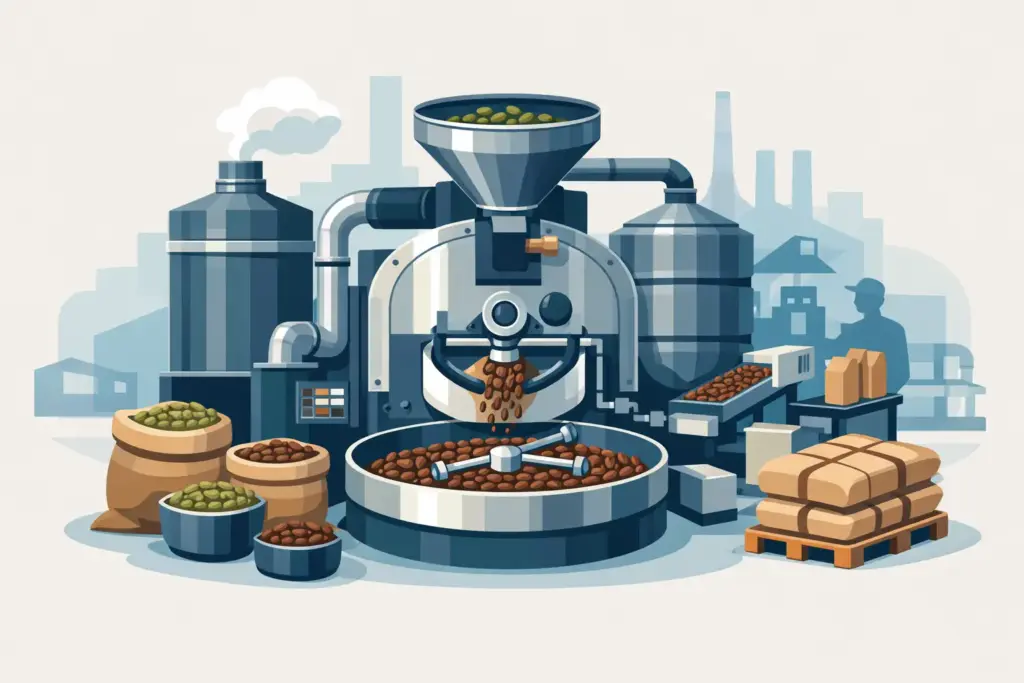
A production roastery usually outgrows its first machine before it outgrows demand. That moment changes the buying criteria fast. Industrial coffee roasters are not just larger versions of small-batch equipment. They are production assets, and they need to perform like it – with stable heat transfer, repeatable control, durable construction, and the ability to run batch after batch without introducing unnecessary variation.
For professional operators, the real question is not whether a machine can roast coffee. Many can. The question is whether it can deliver the same profile on a busy Tuesday afternoon as it did during sample approval, whether it can support a trained team across multiple shifts, and whether its design helps a business scale without sacrificing cup quality.
What defines industrial coffee roasters
The term gets used loosely, but in a professional setting it has a clear meaning. Industrial coffee roasters are built for sustained production, measurable process control, and long service life. Capacity matters, but capacity alone is not enough. A machine becomes truly industrial when its engineering supports consistency under real operating conditions.
That starts with thermal stability. In production, a roaster must recover predictably between batches and maintain controllable energy input through the full roast curve. It also needs accurate sensing, responsive burner behavior, dependable airflow management, and a drum system that transfers heat evenly. If one of those elements is weak, operators end up compensating manually, and manual compensation is where repeatability begins to erode.
An industrial machine also has to fit into a broader workflow. Green coffee intake, batch scheduling, quality control, software logging, afterburner or emission considerations, cooling performance, and routine maintenance all affect how productive the system really is. A high-capacity machine with poor control or service access can slow a roastery more than a smaller machine with disciplined engineering.
Why control matters more than headline capacity
Buyers often begin with batch size because expansion plans usually start with projected volume. That is reasonable, but it can lead to the wrong comparison. A 30 kg roaster that holds stable burner response, drum speed control, and precise airflow adjustment will often create better production outcomes than a larger machine with less responsive controls.
In practice, consistency depends on how accurately an operator can repeat key roast events. Charge temperature, turning point behavior, rate of rise, Maillard progression, development time, and end temperature all become easier to manage when the machine responds in a predictable way. Features such as digital flame control, independent airflow control, and stable temperature feedback are not luxury add-ons in this environment. They are part of the control architecture.
PT100 temperature sensors are a good example. In a professional roasting room, sensor quality directly affects decision quality. Better signal accuracy means more reliable profile tracking, tighter process documentation, and fewer surprises when reproducing a roast across shifts or seasonal green changes. If the data is weak, the profile is only an approximation.
Engineering details that separate serious production machines
The strongest industrial coffee roasters tend to share a similar design logic. They are built around repeatability first, then operator convenience, then aesthetic finish. That order matters.
Burner design is one of the first areas to evaluate. Premix burners are valued in professional settings because they can support efficient combustion and stable flame behavior. That translates into better heat application and more dependable control during production. For roasteries focused on both performance and energy discipline, burner efficiency is not a marketing side note. It affects operating cost and roast stability over time.
Drum construction matters just as much. A double wall drum can help create more controlled thermal behavior and protect against harsh heat spikes that make profiles harder to manage. Combined with adjustable drum speed, it gives the operator more authority over conductive heat transfer and bean movement. That becomes especially useful when moving between dense washed coffees, lower-density naturals, and darker profile requirements in the same production schedule.
Airflow is another area where machine quality becomes obvious quickly. On an industrial roaster, airflow should not feel like a coarse setting with limited range. It should be controllable, responsive, and repeatable. Airflow influences convective transfer, smoke evacuation, and chaff movement, but it also shapes clarity in the cup. A machine with poor airflow control can flatten distinction between profiles, especially when trying to maintain clean results at higher throughput.
Cooling performance is often underestimated during equipment selection. In production, fast and efficient cooling protects the profile you just built. Slow cooling can continue bean development after discharge, reducing control over final roast results. The bigger the batch schedule, the more costly that inconsistency becomes.
Software integration is now part of the equipment decision
A modern production roastery does not rely on memory and handwritten notes alone. Roast data, batch records, profile comparison, and quality tracking are now part of standard professional practice. That is why compatibility with tools such as Artisan and Cropster has become an operational requirement for many buyers.
Software integration supports more than recordkeeping. It allows teams to train around a common process language, compare actual batch behavior against target profiles, and investigate variation with evidence instead of assumption. For multi-operator environments, this is especially important. The machine must support disciplined roasting across different people, not only when the head roaster is on the floor.
There is a trade-off to acknowledge here. More digital control and data visibility can improve consistency, but only if the interface is designed well and the team is trained properly. Technology does not replace roasting skill. It gives skilled operators a more reliable system to work with.
Durability is not a feature list item
Production buyers should treat durability as a core financial factor. Industrial roasters run under heat, dust, vibration, and constant use. Over time, weak materials, lower-grade components, and limited access for maintenance become expensive problems.
This is where build quality shows its real value. Heavy-duty construction, premium branded components, stable mechanical systems, and sensible service access reduce downtime risk and help protect output. A machine that holds calibration, resists wear, and remains serviceable after years of use will support growth far better than one that looked attractive on a quote sheet but was not built for production realities.
Technical support also belongs in the durability conversation. Even the best machine will need guidance, parts, calibration help, or troubleshooting at some point. Around-the-clock support can make a meaningful difference when a roastery is trying to protect delivery schedules. Equipment reliability is not only about what happens when everything works. It is also about how quickly problems get solved when they do not.
Choosing the right industrial coffee roaster for your operation
The right machine depends on the business model behind it. A specialty roastery supplying wholesale accounts may prioritize profile repeatability, software integration, and flexibility across many coffees. A larger production facility may place greater weight on throughput, energy efficiency, and shift-to-shift consistency. A cafe group bringing roasting in-house may need room to scale without overcommitting to a machine that exceeds near-term demand.
That is why equipment selection should begin with production reality, not aspiration alone. Look at current weekly volume, target growth, roast style range, staffing level, QC discipline, and facility constraints. Then evaluate the machine as a system. How stable is the burner response? How usable is the airflow control? How quickly does the cooling tray perform? How accurate is the temperature data? How easily can an operator reproduce a successful profile?
If those answers are strong, the machine is likely built for serious work. If they are vague, scaling will expose the weakness quickly.
R&R approaches this category with a clear engineering philosophy: precision, repeatability, and durability are not separate benefits. They work together. For professional roasters, that is the standard that matters.
A production roastery grows on consistency long before it grows on volume alone. Choose the machine that helps your team roast the same coffee with the same confidence, even when demand stops being simple.