
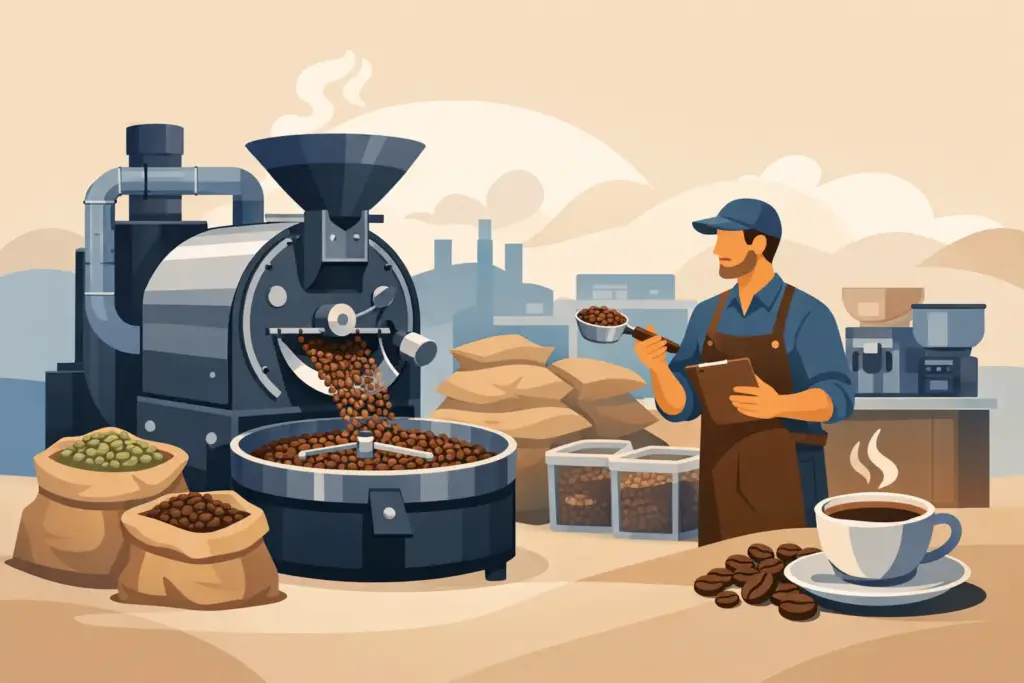
A sample roast can hide a lot. A coffee may taste excellent in a tiny test batch, then fall apart when you try to reproduce it at production scale. That is exactly where the question what is a commercial coffee roaster starts to matter. In professional roasting, the machine is not just a heat source. It is a controlled production system built to deliver repeatable results, batch after batch, under real operating demands.
A commercial coffee roaster is a roasting machine designed for professional use in cafes, roasteries, wholesale operations, and coffee production facilities. It applies heat to green coffee in a controlled way while giving the operator precise command over variables such as burner output, airflow, drum speed, and bean temperature. Unlike home or small sample roasters, commercial systems are built for higher batch capacity, longer operating hours, stronger thermal stability, and consistent roast development across repeated production cycles.
That distinction matters because commercial roasting is not only about reaching a target color or roast level. It is about maintaining flavor consistency, protecting bean quality, managing throughput, and building a process that can scale without losing control.
What is a commercial coffee roaster designed to do?
At its core, a commercial coffee roaster converts green coffee into roasted coffee by transferring heat into the beans over a measured period of time. But in a production environment, the real job is broader. The machine must create enough energy to roast efficiently, respond accurately to adjustments, and hold stable conditions from one batch to the next.
A professional roaster needs predictable thermal behavior. If the machine reacts too slowly, profile adjustments become blunt and inefficient. If it reacts too aggressively, consistency suffers and defects become more likely. A well-engineered commercial coffee roaster balances thermal mass, burner control, airflow design, and drum mechanics so the operator can shape development with precision instead of guesswork.
This is why serious roasting businesses invest in systems with features like digital flame control, adjustable airflow, stable drum rotation, and precise temperature sensing. Those are not luxury additions. They are operational tools that support repeatability and reduce unnecessary variation.
How a commercial coffee roaster works
Most commercial coffee roasters use a rotating drum and a gas burner, though electric configurations exist in some markets and applications. Green coffee is charged into the preheated drum, where it is exposed to conductive, convective, and to a lesser extent radiant heat. As the beans absorb energy, they lose moisture, change color, expand, and move through the chemical stages that create aroma, sweetness, acidity, and body.
The machine’s control systems govern how that heat is delivered. Burner settings affect overall energy input. Airflow influences heat transfer, smoke removal, and the roasting environment inside the drum. Drum speed affects bean movement and contact behavior. Temperature sensors track bean and environmental conditions, giving the operator data to guide timing and adjustments.
In a modern production setup, these controls often work alongside roast profiling software. Integration with platforms such as Artisan or Cropster allows teams to record curves, compare batches, train operators, and build a more disciplined quality-control process. For a professional roasting facility, that visibility is a major part of machine value.
What separates commercial roasters from smaller machines
The biggest difference is not simply size. Capacity matters, but engineering depth matters more.
A home or entry-level machine may roast coffee successfully in small quantities, yet still fall short in a production setting. Commercial coffee roasters are built to handle repeated daily use, often under demanding schedules. They need stronger materials, better insulation, more durable motors, more stable burners, and a frame that tolerates long-term thermal stress.
They also need more precise control. A small machine can sometimes rely on operator intuition because the stakes are lower and batch volume is limited. A production roaster cannot operate that way for long. Once a business is supplying wholesale accounts, running multiple origins, or managing larger roast schedules, variation becomes expensive. Waste increases, labor becomes less efficient, and customer trust can erode.
This is where industrial-grade construction and measurable control become essential. Double-wall drums, premix burner systems, PT100 temperature sensors, and responsive airflow management all contribute to a roasting environment that is more stable and more repeatable. Built correctly, the machine becomes a platform for quality rather than a source of uncertainty.
Why control is the real value
When buyers ask what is a commercial coffee roaster, they often focus first on capacity. That is understandable, but capacity alone does not define performance. A 15-kilo machine with weak control can be less valuable than a smaller machine with stronger thermal response and cleaner data.
Control is what allows a roastery to preserve a profile across production days, environmental shifts, and different operators. It is what helps a team make intentional changes when a coffee’s density or moisture calls for a different approach. It is what gives production managers confidence that the fifth batch will behave like the first.
This is also where software compatibility and sensor accuracy matter. If temperature readings drift or controls respond inconsistently, the operator is forced to compensate manually, and that introduces more variation. On the other hand, a machine with stable burner modulation, accurate probes, and clean airflow design gives the team a stronger foundation for consistent roasting decisions.
What to look for in a commercial coffee roaster
For most professional buyers, machine selection comes down to how well the roaster supports quality, uptime, and growth.
Construction quality should be examined first. The frame, drum design, insulation, burner components, and mechanical systems all influence longevity and roast stability. Production equipment should be built to last, not optimized only for showroom appeal.
Then look at the control architecture. Can the operator adjust flame precisely? Is airflow independent and responsive? Does drum speed offer meaningful control or just a basic setting? Are the sensors accurate enough for serious profile work? These questions tell you far more than a simple capacity number.
Serviceability is another factor that gets underestimated. A commercial coffee roaster is a critical production asset. When maintenance is difficult or support is weak, downtime becomes costly very quickly. Professional operators need access to dependable technical assistance, spare parts planning, and a machine layout that makes routine maintenance realistic.
Efficiency also deserves a practical evaluation. Better insulation, cleaner combustion, and well-designed airflow can improve fuel use and support a more controlled roast environment. But efficiency claims should always be considered alongside cup quality, responsiveness, and long-term reliability. Saving energy means little if the machine cannot deliver stable results.
It depends on your production model
There is no single best commercial coffee roaster for every business because operating goals are different.
A specialty roastery focused on high-transparency single origins may prioritize detailed control, high data visibility, and the ability to make fine profile adjustments. A wholesale brand with larger blends may place more value on throughput, thermal recovery, and schedule efficiency. A cafe group bringing roasting in-house may need a machine that balances production capacity with manageable training demands for staff.
Future growth should be part of the decision as well. Buying too small can force an expensive transition sooner than expected. Buying too large can reduce flexibility and create unnecessary operating costs. The right machine fits current production while giving the business room to grow without compromising roast quality.
For that reason, serious equipment manufacturers focus not only on machine output, but on repeatable performance under real commercial conditions. R&R, for example, positions its roasters around precision, durability, and advanced control because those are the factors that matter most once roasting becomes a professional operation rather than a side activity.
What is a commercial coffee roaster really buying you?
It is buying consistency. It is buying process control. It is buying the ability to turn roasting knowledge into repeatable production.
A commercial coffee roaster should help a business reduce variability, train operators more effectively, capture better roast data, and maintain quality as volume increases. It should perform as a dependable production tool, not just a machine that gets beans brown.
That is the standard professional buyers should use. Not whether the roaster looks impressive on the floor, but whether it gives the team the precision, durability, and control required to roast with confidence every day.
If you are evaluating equipment, start with the realities of your operation: batch volume, workflow, staffing, quality targets, and growth plans. The right machine is the one that turns those demands into stable, measurable roast performance – and keeps doing it long after the installation is complete.