
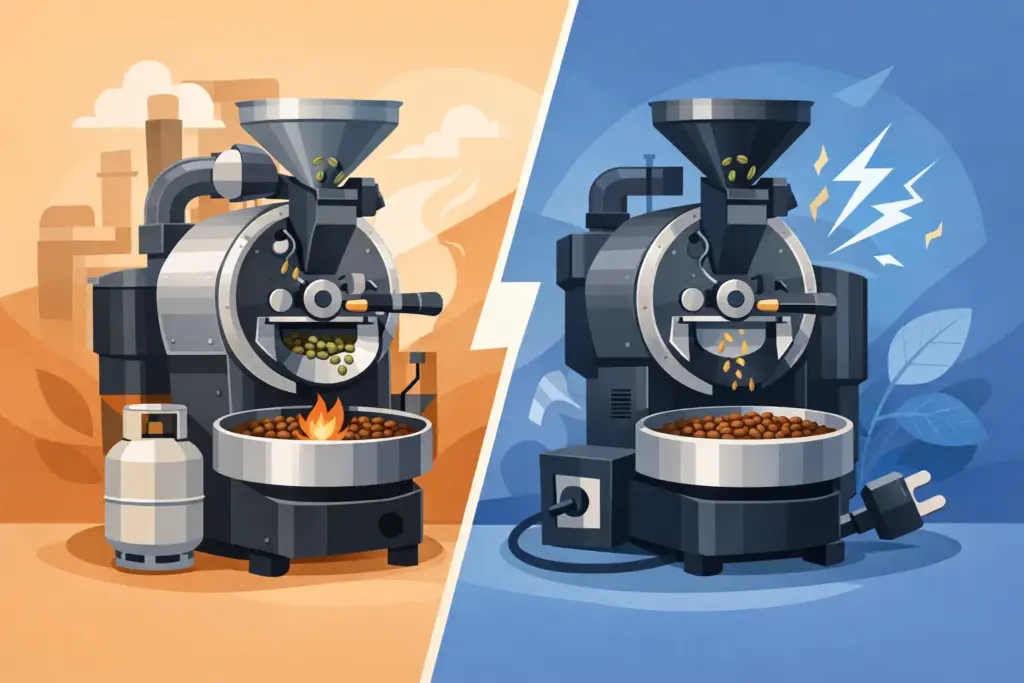
The choice between a gas vs electric coffee roaster usually stops being theoretical the moment a production schedule, utility quote, or ventilation plan lands on your desk. For commercial roasters, this is not a lifestyle preference. It is a decision that affects heat application, batch repeatability, operating cost, infrastructure requirements, and how confidently you can scale.
At a distance, the debate sounds simple. Gas is often associated with power and traditional roasting, while electric is framed as cleaner and easier to install. In practice, the right answer depends on batch size, facility constraints, target throughput, and how much control your operation expects from the machine. A serious roasting business needs to evaluate the entire system, not just the heating source.
Gas vs electric coffee roaster: what actually changes?
The biggest difference is how heat is generated and transferred into the roasting environment. A gas roaster uses a burner system to create heat, typically with precise modulation of flame intensity. An electric roaster relies on electric heating elements to produce heat that is then managed through airflow, drum design, and control logic.
That difference sounds narrow, but it shapes the way the machine responds during critical moments of the roast. Charge temperature recovery, rate of rise management, turning point behavior, and development phase control can all feel different depending on the heating system and the quality of the machine’s engineering.
For professionals, the real question is not whether gas or electric can roast good coffee. Both can. The real question is which platform gives your team the control, consistency, and production reliability your business requires.
Heat response and roast control
In commercial roasting, responsiveness matters. A roaster that reacts predictably to operator inputs is easier to profile, easier to repeat, and easier to trust during long production days.
Gas systems are often favored for their strong heat delivery and rapid response, especially in medium to larger production environments. When paired with advanced burner technology and stable control systems, gas can offer fine adjustments across the roast curve. This is one reason many production roasteries continue to prefer gas-fired machines for high-output operations. A well-engineered gas system does not simply produce heat. It delivers controllable energy that can be shaped throughout drying, Maillard, and development.
Electric systems can also provide precise control, particularly when paired with strong sensor feedback and well-tuned software. In some designs, electric heat offers a very stable thermal input, which can be attractive for operators focused on repeatability. The limitation is not that electric cannot be precise. It is that the quality of control depends heavily on element performance, control architecture, and the machine’s ability to respond quickly enough when the roast demands correction.
This is where engineering separates categories from assumptions. A commercial roaster with accurate temperature sensing, controlled airflow, and dependable drum dynamics can outperform a poorly designed machine regardless of whether it is gas or electric.
Capacity and production demands
If your business is building around sustained daily output, batch capacity changes the conversation quickly. Smaller operations may be able to choose based on utility access, local regulations, or desired workflow. Larger operations usually need to prioritize production efficiency and thermal performance first.
Gas roasters are commonly selected for higher-capacity production because they can deliver substantial heat energy efficiently across repeated batches. In a demanding production environment, that matters. Recovery between batches, consistency across back-to-back runs, and the ability to maintain momentum through a full roasting day all affect labor efficiency and cup quality.
Electric roasters can be an excellent fit in smaller commercial settings, pilot roasting applications, and facilities where gas infrastructure is limited or prohibited. They may also appeal to businesses that prioritize simplified utility planning or are operating in buildings with strict emissions or installation constraints. But when production volumes rise, operators need to verify that the machine can maintain thermal stability without compromising roast agility.
In other words, electric can be commercially viable, but the margin for poor design becomes more visible as throughput increases.
Installation, ventilation, and facility planning
This is where many buyers underestimate the true scope of the decision. The roaster itself is only one part of the project. Utility availability, permitting, afterburner requirements, exhaust design, and compliance obligations can make one heating source more practical than the other.
Gas roasters generally require gas supply planning, burner setup, and proper exhaust integration. Depending on local code, your facility may also need specific safety systems, permits, and inspections. That sounds like added complexity because it often is. However, for many established production sites, those requirements are normal and manageable.
Electric roasters may reduce some aspects of gas line planning, but they are not automatically simple installations. Electrical demand can be significant, especially at commercial capacities. Your panel, wiring, and building service must support the machine under production load. In some facilities, upgrading electrical infrastructure is more disruptive or expensive than adding gas service.
The practical lesson is straightforward. Do not compare gas and electric in isolation. Compare full installation realities at your site.
Operating cost and efficiency
A gas vs electric coffee roaster comparison often turns into a cost discussion, but blanket statements are unreliable. Energy pricing varies by region, and facility usage patterns change the math.
In many markets, gas remains the more economical energy source for larger roasting operations, particularly when used in efficient burner systems designed for stable combustion and controlled heat application. That cost advantage becomes more meaningful as production hours and batch volume increase.
Electric roasting may offer predictable energy usage and, in some locations, favorable utility structures. It can also align with businesses pursuing certain sustainability targets, especially where electricity is sourced from lower-emission grids. But electricity rates can also be high, and demand charges may affect total operating cost in ways buyers do not initially model.
Efficiency is not just about the power source. Drum insulation, burner or element design, airflow efficiency, heat retention, and control accuracy all influence how much usable roasting performance you get from each unit of energy.
Flavor development and roast character
This part of the discussion tends to attract the strongest opinions and the weakest generalizations. Some roasters insist gas produces a more dynamic roasting environment. Others value the steadiness of electric systems. Both viewpoints can be valid in specific contexts.
What matters most is not mythology around heat source. It is the machine’s ability to apply energy evenly, respond to control inputs, and support intentional profile development. Poor airflow control, unstable temperature readings, or sluggish response will create problems regardless of the heating method.
For specialty production, cup quality comes from repeatable execution. The machine must support clean development, consistent momentum, and reliable end-point control. That requires more than heat. It requires accurate sensors, well-managed airflow, stable drum mechanics, and a control system that gives operators confidence.
Which roaster fits which business?
A gas roaster is often the stronger choice for commercial operations that need higher throughput, fast thermal recovery, and proven performance under sustained production. It is especially compelling when the business plans to scale, profile across multiple coffees, or maintain tight consistency across long roasting runs. With the right engineering, gas offers strong control potential and operational efficiency.
An electric roaster can make sense for smaller commercial setups, research and development labs, training environments, and locations where gas access is impractical. It may also suit businesses that place installation simplicity or site restrictions above maximum output flexibility. The key is to validate that the machine delivers the responsiveness and repeatability your production standards demand.
For many professional buyers, the decision is less about ideology and more about risk. Which system gives your business fewer operational compromises over the next five to ten years?
The better question than gas or electric
Instead of asking only whether a roaster is gas or electric, ask how well it is built to manage heat. That means looking at burner design or element quality, airflow control, drum construction, insulation, temperature sensor accuracy, software compatibility, and service support.
A professional roastery depends on repeatable performance. Features such as digital flame control, drum speed adjustment, precise airflow management, and high-accuracy PT100 temperature sensors matter because they reduce variation and strengthen profile control. Compatibility with production software also matters because modern roasting is not just about making heat decisions in real time. It is about documenting, analyzing, and repeating them.
That is why experienced buyers tend to focus on total machine capability. At the commercial level, a roaster is a production asset. It has to deliver consistency, durability, and measurable control, batch after batch.
R&R builds roasting systems for exactly that standard of operation, where engineering discipline and roast repeatability are not optional features but baseline expectations.
If you are choosing between gas and electric, start with your production reality. Look at your facility, your batch targets, your utility structure, and your quality-control process. The right machine is the one that gives your team stable performance today without limiting what your roasting business needs next year.