
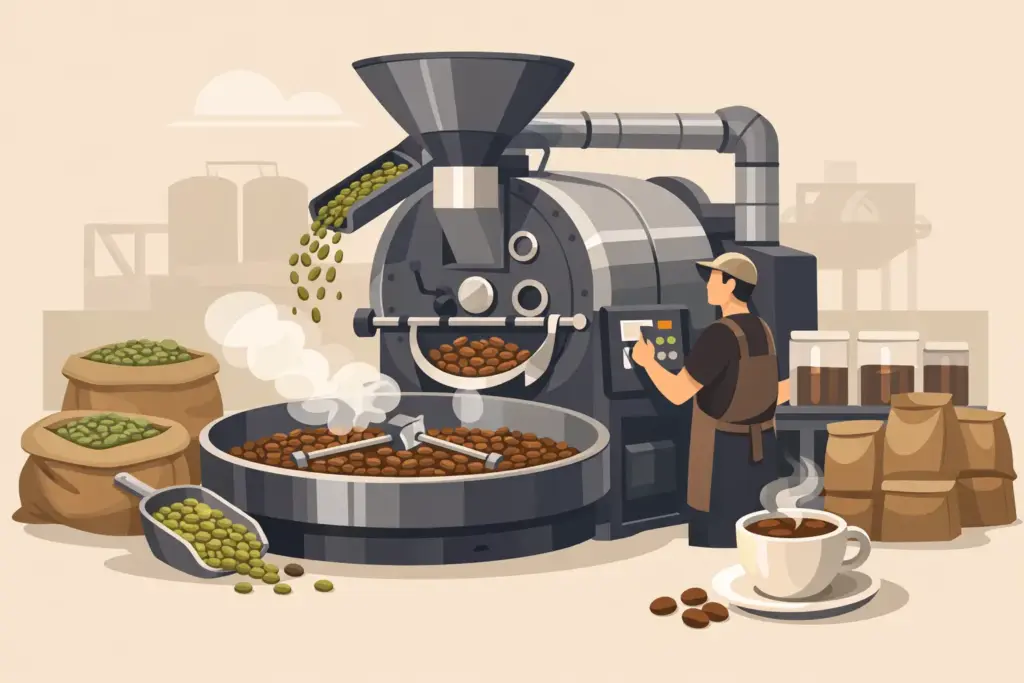
A coffee that tastes clean and expressive at 5 kilos can fall apart at 30 if the roast system is not built for control. That is the real challenge in learning how to commercially roast coffee beans. Commercial roasting is not simply making a larger batch. It is managing heat transfer, airflow, bean movement, and data with enough precision to produce the same result day after day.
For production teams, consistency is the standard that matters. Customers expect the same espresso profile every week. Wholesale accounts expect stable solubility and color. Quality control teams need clear roast data, not guesswork. Commercial roasting starts where small-batch intuition stops being enough.
What commercial roasting actually requires
At a professional level, roasting is a controlled thermal process with business consequences. A roast that runs too fast can mute sweetness and create sharp acidity. A roast that stalls can flatten the cup and reduce clarity. In a production environment, those issues are not isolated mistakes. They affect inventory planning, blend targets, customer satisfaction, and margin.
That is why commercial roasting depends on equipment that can hold stable energy, respond predictably to adjustments, and provide usable data. Drum design, burner behavior, airflow range, sensor quality, and software compatibility all matter because they shape the repeatability of every batch.
A commercial operator also has to think beyond flavor alone. Throughput, cooling time, fuel efficiency, maintenance access, smoke management, and operator training all influence how well a roasting line performs. Good coffee is the goal, but reliable production is what sustains the business.
How to commercially roast coffee beans with repeatable results
The process begins before green coffee enters the hopper. Commercial roasting works best when every variable that can be standardized is standardized. That includes green grading, moisture awareness, batch size, charge temperature, gas application, airflow settings, and cooling procedure.
Start with a machine built for control
A commercial roaster should give the operator clear authority over the major roast variables. Heat input must be responsive and stable. Airflow should be adjustable enough to manage convection and smoke removal without stripping the roast. Drum speed should support even bean movement for different densities and batch loads.
Sensor accuracy is just as important. Professional roasting decisions depend on trustworthy temperature readings, especially when building profiles across multiple coffees. PT100 sensors, digital flame control, and consistent airflow feedback are not luxury features in this context. They are part of basic process control.
Machine construction matters too. A well-engineered drum, stable burner system, and durable components reduce variation that operators cannot see directly. Inconsistent hardware creates inconsistent roasts, even when the profile looks correct on paper.
Match the batch size to the machine
One of the most common production mistakes is treating the rated capacity as the only useful batch size. Commercial roasters perform best within a practical operating window, not at every load point equally. Running too small a batch may weaken thermal momentum. Running too large a batch may compress development and reduce control.
The right target depends on the coffee, the profile objective, and the roaster’s thermal design. Dense washed coffees often tolerate a different energy approach than softer natural coffees. Espresso and filter targets also demand different development structure. Commercial roasting means understanding that batch size is part of the profile, not just a scheduling number.
Build a clear roast profile framework
A good production profile is not just a curve that once tasted good. It is a repeatable operating plan. That plan should define charge temperature, initial gas setting, airflow progression, turning point expectations, yellowing range, first crack timing, development time, drop temperature, and cooling method.
This does not mean every coffee should follow the same shape. It means every coffee should have a profile logic that the team can execute consistently. Some coffees benefit from stronger early energy and cleaner airflow later. Others need a more moderated approach to preserve sweetness and avoid surface scorching. The key is that changes are intentional and documented.
Software integration is especially valuable here. Platforms such as Artisan or Cropster allow operators to compare live batches against target curves, track rate of rise behavior, and spot drift before quality slips. In commercial production, roast data is not optional. It is part of quality assurance.
Heat, airflow, and drum speed are the core system
If you want to understand how to commercially roast coffee beans at a high level, focus on the interaction between heat, airflow, and bean movement. Most roast defects come from imbalance among those three.
Heat input sets the direction of the roast
The roast needs enough energy to move cleanly through drying and Maillard without losing momentum. Too little energy early can force the operator to chase the roast later, often leading to baked character or weak development. Too much energy can create tipping, scorching, or a roast that races to first crack without building internal sweetness.
Commercial burners with stable modulation make a major difference. Digital flame control allows smaller, more accurate corrections than manual adjustments alone. That precision is critical when the goal is repeatability across many batches in a shift.
Airflow shapes cleanliness and development
Airflow is often underestimated by newer operators moving into commercial production. It does more than remove chaff and smoke. It changes convective heat transfer and influences how clearly a coffee presents in the cup.
Low airflow can increase smoky character and reduce clarity. Excessive airflow can pull too much heat or create a roast that tastes dry and thin. The right setting changes during the roast. Many production roasters increase airflow in stages to keep the environment clean while protecting momentum. This is one area where responsive machine design and operator training work together.
Drum speed supports even bean movement
Drum speed affects how beans contact conductive surfaces and how evenly they mix in the drum. That matters for color consistency and surface integrity. A fixed-speed system can still produce good coffee, but adjustable drum speed provides another useful control point for different coffees and batch sizes.
In practical terms, this helps operators manage the roast environment with more precision rather than compensating too heavily with gas alone.
Production roasting depends on disciplined quality control
Commercial roasting is not finished at drop. Color tracking, cupping, moisture and weight loss review, and batch record analysis all help confirm whether the roast performed as intended.
A professional production floor should be able to answer simple questions quickly. Did this batch follow target milestones? Did the airflow change at the planned point? Was development consistent with the approved profile? Did the cooling cycle complete fast enough to stop carryover heat? If the answer relies on memory instead of records, the process is not yet commercial grade.
This is also where equipment reliability becomes a strategic advantage. Roasters built with premium materials, stable burner systems, and production-focused controls support better decision-making because they reduce noise in the process. Operators can focus on coffee rather than fighting inconsistent machine behavior.
Scaling without losing cup quality
Scaling a roasting business exposes weaknesses fast. A profile that works when the head roaster is present may break down when multiple operators run the machine. A machine that feels acceptable at low output may become inefficient or inconsistent under full production demand.
The answer is not more improvisation. It is stronger systems. Standard operating procedures, profile libraries, software-based batch tracking, preventive maintenance, and equipment designed for repeatable output all protect quality as volume grows.
For serious roasting operations, this is where engineering matters most. A commercial roaster should be built to last, built to respond, and built to produce measurable consistency. R&R approaches roasting equipment from exactly that performance standard, with control features and industrial construction intended for real production environments.
The best commercial roasting programs are not defined by dramatic profile changes or operator guesswork. They are defined by stable machines, disciplined process control, and a team that knows why each adjustment is being made. If you want better coffee at commercial scale, start by building a roast system that performs as consistently as your customers expect.