If you are asking how much are commercial coffee roasters, you are probably already past the hobby stage. At that point, price is not just about getting heat into a drum. It is about production capacity, repeatability, control, serviceability, and how confidently your operation can grow without replacing core equipment too soon.
Commercial roaster pricing spans a wide range because the machines themselves do very different jobs. A small shop roasting a few batches a day does not need the same build quality, burner design, airflow control, software integration, or thermal stability as a wholesale producer running full production schedules. The right question is not only what a machine costs to buy, but what it costs to operate, maintain, and rely on for years.
How much are commercial coffee roasters by size?
In broad terms, small commercial coffee roasters often start around $8,000 to $20,000 for lower-capacity machines. Mid-range production roasters commonly land between $20,000 and $60,000. Larger industrial and high-output specialty roasters can move from $60,000 to well over $150,000, especially when advanced controls, emissions equipment, and custom production configurations are involved.
That spread exists for a reason. Batch size is one factor, but not the only one. Two machines with similar stated capacity can differ dramatically in roast consistency, thermal response, material quality, safety systems, data logging, and long-term durability.
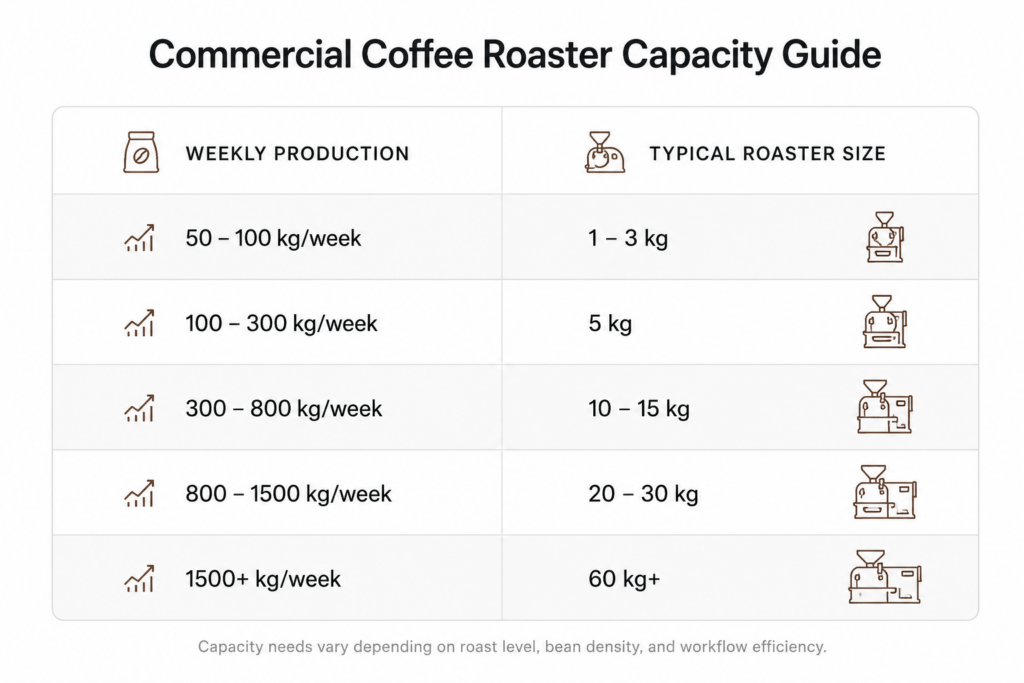
A 1 kg to 3 kg machine may be suitable for lab work, education, menu development, or very small-batch retail roasting. A 5 kg to 15 kg roaster is often where serious specialty businesses begin to balance flexibility with meaningful production. Once you move into 20 kg, 30 kg, 60 kg, and above, the investment shifts toward throughput, efficiency, and process control at scale.
What actually drives the price?
The biggest mistake buyers make is comparing commercial roasters as if they were interchangeable metal drums with burners attached. Professional roasting equipment is a system. Pricing reflects how well that system is engineered.
In our experience working with commercial roasting operations, many buyers initially focus on batch capacity. However, after commissioning, factors such as airflow responsiveness, burner stability, sensor accuracy, and software integration often have a greater impact on day-to-day production than nominal batch size alone.
Capacity is only the starting point
Larger roasters cost more because they require more material, more powerful burner systems, stronger motors, and more substantial structural components. But capacity alone does not explain the full difference. A well-engineered 15 kg roaster may cost more than a lightly built 20 kg machine because performance under production conditions matters more than a number on a spec sheet.
A roaster that holds temperature stability, responds predictably to adjustments, and supports repeatable profiles will often deliver stronger value than a larger machine that struggles with consistency from batch to batch.
Construction quality changes the economics
Premium materials and industrial-grade components raise the initial purchase price, but they also change the machine’s working life. Drum design, insulation, bearing quality, burner assembly, motors, sensors, and control hardware all affect reliability.
For professional operators, downtime is expensive. A lower-cost machine can become a higher-cost asset if it introduces inconsistency, frequent repairs, poor parts availability, or weak support when production schedules are tight.
Control systems add real value
Manual machines are less expensive, but advanced control systems are often worth the premium in a commercial setting. Digital flame control, adjustable airflow, drum speed control, and accurate bean and environmental temperature readings allow roasters to make deliberate, repeatable decisions instead of chasing unstable behavior.
That matters even more for teams. When multiple operators use the same machine, precise control architecture helps standardize outcomes. It also reduces the gap between a highly experienced head roaster and a trained production team following established profiles.
Software compatibility matters more than many buyers expect
As production grows, data becomes operational infrastructure. Machines that integrate cleanly with software platforms such as Artisan or Cropster support profile development, training, batch analysis, and quality assurance.
This can feel optional for a small startup. It stops feeling optional once you are managing wholesale accounts, multiple roast levels, or several operators across recurring production runs. Software-ready equipment usually costs more up front, but it supports process discipline that protects margin and product quality.
Price ranges by business stage
For a startup specialty roastery, commercial roasting equipment often falls in the $15,000 to $40,000 range once practical features are included. That may cover a smaller production roaster, basic installation needs, and essential workflow tools. Buyers at this stage usually need flexibility, room for profile development, and enough output to support early wholesale growth without immediately outgrowing the machine.
For an established local roaster or cafe group bringing roasting in-house, budgets more often move into the $30,000 to $80,000 range. At this level, buyers tend to focus less on entry price and more on batch consistency, roast control, production efficiency, and technical support. The machine is no longer a trial investment. It is becoming a production asset.
For larger wholesale, private-label, or multi-site operations, pricing can easily exceed $80,000 and continue upward depending on capacity, emissions requirements, automation, and plant layout. These buyers are usually evaluating labor efficiency, output per shift, maintenance access, and repeatability across higher daily volumes.
The hidden costs around the roaster
The machine price is only part of the investment. A commercial roasting project also includes infrastructure, compliance, and production support.
Installation can add meaningful cost depending on gas configuration, ventilation, electrical requirements, and local code compliance. Afterburners or other emissions-control equipment may be necessary in some facilities. Destoners, green coffee loaders, silos, cooling support equipment, and packaging integration can also expand the budget quickly.
One of the most overlooked costs is future expansion. A roaster that cannot integrate with data logging software, external sensors, automation systems, or production management tools may require costly upgrades later.
Then there is the cost of training and commissioning. A machine with advanced capabilities only creates value if the team knows how to use it correctly. That is why technical support should be treated as part of the purchase, not an afterthought.
Why cheaper is not always less expensive
A low-priced commercial roaster can look attractive on paper, especially when capital is tight. But production businesses rarely benefit from buying for the shortest possible budget horizon.
If a machine delivers uneven heat transfer, limited control authority, unstable airflow behavior, or weak sensor accuracy, the cost appears later. It shows up in wasted coffee, inconsistent profiles, slower training, operator frustration, and accounts that notice quality drift.
The same principle applies to service. Professional roasting operations need confidence that spare parts, troubleshooting, and technical guidance are available when needed. That support has value because it protects uptime.
R&R, for example, positions its equipment around precision roast control, industrial-grade construction, and long-term performance because serious roasters do not buy machinery for a season. They buy infrastructure for the next phase of growth.
How to judge value, not just price
The most useful way to compare machines is to connect the price to operational outcomes. Ask how the roaster performs under repeated production loads, how stable the burner and airflow systems are, how responsive the controls feel during development and production roasting, and how well the machine supports consistent results across different coffees.
Also ask how the design supports maintenance. Accessible components, quality sensors, dependable motors, and proven branded parts can simplify ownership over time. A machine built with durability in mind usually pays back through lower disruption and more predictable operation.
There is also a scaling question. If you expect volume to rise sharply within 12 to 24 months, buying too small can be expensive. If your business depends on experimentation, microlots, or frequent profile variation, oversizing can also create inefficiency. The right machine should fit current demand without trapping future growth.
So, how much should you expect to spend?
Most professional buyers should expect a realistic starting point of at least $15,000 to $30,000 for a true commercial coffee roaster that can support serious small-scale production. Once you move into stronger engineering, more advanced roast controls, better thermal management, software integration, and larger capacities, the investment commonly rises into the $30,000 to $80,000 range and beyond.
For larger production environments, six-figure budgets are not unusual. That does not automatically mean overpaying. In many cases, it reflects better design, higher throughput, stronger component quality, and tighter process control – all of which matter when every batch has to meet the same quality standard.
The useful benchmark is not the lowest advertised number. It is the cost of owning a machine that delivers repeatable roast performance, supports your team, and stays dependable under commercial workload. When the roaster becomes the center of production instead of the source of uncertainty, the investment starts to make sense.
R&R Insight: Choosing the Right Capacity
A common mistake is purchasing based solely on current production volume.
For example, a business roasting 150 kg per week today may outgrow a small machine much sooner than expected if wholesale demand increases.
Capacity planning should consider projected growth, workflow efficiency, batch frequency, and labor requirements rather than current output alone.