
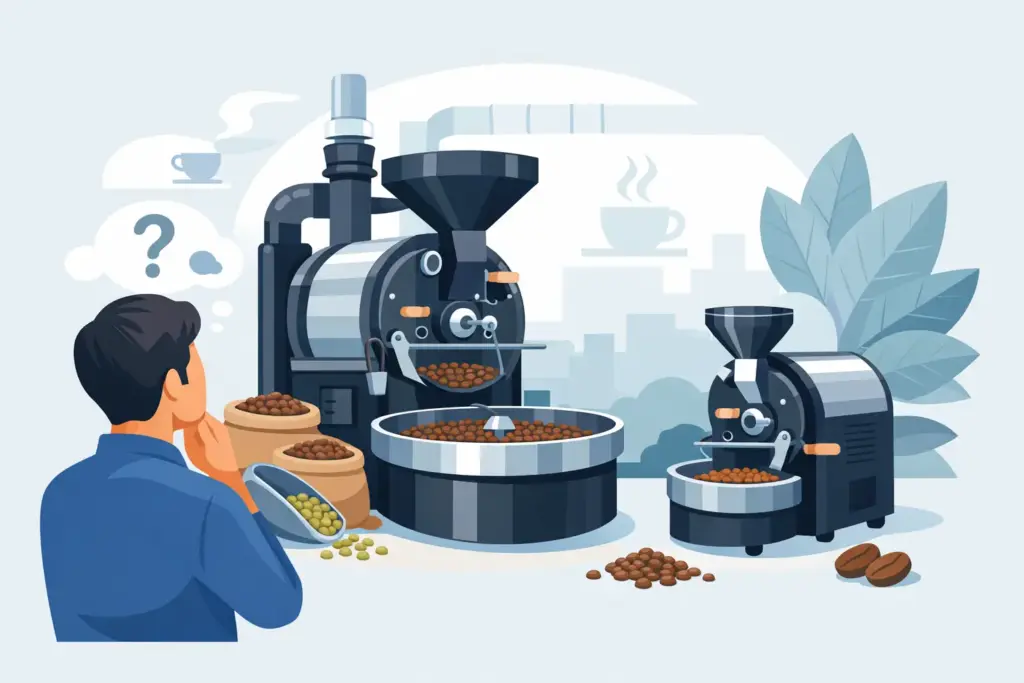
A commercial coffee roasting machine is not just a production asset. It defines how consistently you can hit target profiles, how efficiently your team can work, and how confidently your business can scale. When batch quality, throughput, fuel efficiency, and roast repeatability all matter at once, equipment decisions stop being cosmetic and become operational.
What a commercial coffee roasting machine must do
At a professional level, roasting equipment has one job: produce repeatable results under real production pressure. That means stable heat delivery, responsive control, accurate sensing, and mechanical durability over years of daily use. A machine that looks impressive but drifts from batch to batch will cost more in lost coffee, labor, and inconsistency than it saves upfront.
This is why serious buyers evaluate more than drum size. Burner design, airflow responsiveness, sensor quality, cooling performance, and software compatibility all affect the cup. So does the machine’s construction. Thin materials, weak motors, or inconsistent component quality usually show up later as maintenance interruptions, unstable roasts, or limited control at critical stages of development.
A commercial roaster should also fit the way your business actually runs. A wholesale operation producing multiple blends each day has different needs than a specialty roastery focused on smaller lots and profile development. The best machine is the one that matches both your current workflow and the production level you expect to reach.
Capacity is only the starting point
Roaster size is often the first filter, but it should never be the only one. Buying too small can create immediate bottlenecks. Buying too large can reduce flexibility, especially if your menu includes micro lots or frequent profile changes.
Capacity planning should account for weekly roasted volume, peak production windows, labor scheduling, and desired batch frequency. If you need to roast 1,000 pounds per week, your decision should reflect not only nominal batch size but total roast cycle time, cooling speed, preheating demands, and operator turnover between batches.
A 15 kg machine and a 30 kg machine may both fit the same monthly output on paper, but they create very different production rhythms. Smaller machines can offer flexibility and tighter control over varied coffees. Larger machines can improve labor efficiency and support growth, but only if your demand, green inventory flow, and packaging line can keep pace.
Control systems separate professional machines from basic ones
The difference between average and high-performance roasting equipment is often control precision. In commercial production, broad heat adjustments are not enough. Operators need responsive and repeatable control over flame, airflow, and drum speed to shape development with confidence.
Flame, airflow, and drum speed
Digital flame control matters because gas application needs to be consistent, measurable, and easy to repeat. Manual systems can work in skilled hands, but digital control reduces variation and improves profile repeatability across shifts and operators.
Airflow control is equally important. It affects heat transfer, smoke removal, chaff movement, and cup clarity. On some coffees, aggressive airflow helps preserve a cleaner profile. On others, a more restrained approach supports body and sweetness. A machine that gives you meaningful airflow adjustment opens more room for profile refinement.
Drum speed control adds another layer. It changes bean movement, influences conductive heat exposure, and helps operators adapt to density, moisture, and batch behavior. Not every production environment uses drum speed changes aggressively, but having that capability expands control where it counts.
Temperature data you can trust
Roasting decisions are only as good as the information behind them. PT100 temperature sensors are valuable in commercial environments because they offer stable, accurate readings that support profile consistency and better data tracking. Inferior sensing leads to guesswork. Better sensors support better coffee and better process control.
When operators can rely on bean and environmental readings, they can make smaller, smarter adjustments throughout the roast. That becomes even more important when training staff, reproducing successful batches, or managing several coffees with different thermal behavior.
Build quality is a production issue, not a branding detail
A commercial coffee roasting machine should be engineered for long-term thermal stability and mechanical reliability. In production settings, build quality is not about appearance. It affects uptime, maintenance frequency, operator confidence, and consistency from one day to the next.
Double wall drum construction, for example, can contribute to more stable roasting conditions and improved heat management. Premium burners, motors, bearings, and industrial-grade components tend to hold performance more consistently over time. Premix burner systems can also improve combustion efficiency and support cleaner, more controlled energy delivery.
This is where many purchasing decisions become shortsighted. A lower-cost machine may appear attractive at the start, but if it produces erratic heat response, requires frequent service, or wears prematurely under production loads, the true cost rises quickly. Lost batches, schedule interruptions, and inconsistent coffee are expensive.
Software compatibility is now part of the standard
Professional roasting is increasingly data-driven. A machine that integrates cleanly with software platforms like Artisan or Cropster fits more naturally into modern quality control systems. For growing roasteries, that compatibility is no longer a bonus feature. It is part of how production stays organized and repeatable.
Roast logging helps teams compare batches, identify drift, train operators, and maintain standards across volume growth. It also creates accountability. When profile changes are documented clearly, it becomes easier to evaluate whether a result came from the coffee, the machine, or the operator.
For businesses managing multiple accounts, blends, and seasonal coffees, software integration reduces friction. It supports a production environment where decisions are based on measured performance rather than memory.
Efficiency matters, but not at the expense of control
Fuel efficiency and environmental performance are legitimate buying factors, especially as energy costs rise and facility planning becomes more demanding. But efficiency should be evaluated alongside roast quality and responsiveness, not apart from them.
A machine that uses energy wisely while maintaining precise heat application offers a better long-term return than one that simply advertises lower consumption. Efficient burner design, proper insulation, and stable thermal engineering all contribute to this balance.
The same logic applies to cooling. Fast, effective cooling protects roast integrity and improves production flow. If cooling is weak, carefully developed coffees can continue changing after discharge, and turnaround time between batches slows down. That is a quality issue and a throughput issue at the same time.
Support should be part of the purchase decision
Even the best-engineered machine will eventually need setup guidance, maintenance support, or troubleshooting. For commercial operators, service responsiveness matters because downtime affects revenue, fulfillment, and customer trust.
Technical support should be evaluated with the same seriousness as machine specifications. Buyers should ask practical questions. How quickly can support respond? Is training available? Are replacement parts accessible? Can the manufacturer assist with installation planning and production optimization?
This is one reason established manufacturers with global installations hold an advantage. They have already seen a wide range of operating environments, production demands, and service scenarios. That experience tends to translate into better support and more realistic guidance.
How to evaluate a commercial coffee roasting machine for your operation
The strongest buying process starts with production reality, not showroom appeal. Define your weekly and monthly volume targets, product mix, staffing level, and quality-control expectations. Then evaluate machines based on whether they can hold profile consistency under those conditions.
Look closely at the control package. If your team values exact repeatability, digital flame control, airflow control, drum speed adjustment, and accurate temperature sensing should be high on the list. If software-based roast management is part of your workflow, compatibility should be confirmed early rather than treated as an afterthought.
It is also worth looking beyond launch-day performance. Ask how the machine is built, which branded components it uses, how it manages heat stability, and what kind of support stands behind it. A serious production machine should be built to last, not simply built to sell.
For many professional roasteries, the right answer is a machine that balances industrial durability with precise roast control. That combination supports consistency now and gives the business room to grow without changing its standards. Manufacturers such as R&R have built their position around exactly that requirement: repeatable roast performance backed by engineering discipline and technical support.
The best equipment decision is rarely the cheapest or the flashiest. It is the one that keeps your profiles stable, your operators confident, and your production moving when demand increases.