
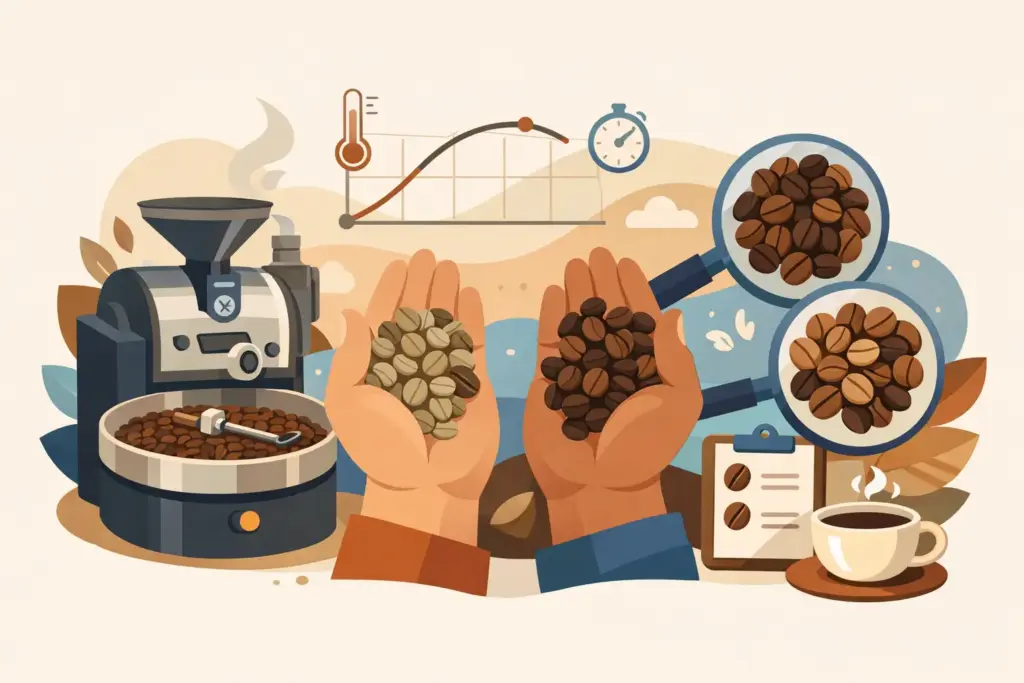
One batch lands exactly where you want it, and the next drifts just enough to create problems on the cupping table. That gap is where margin, quality, and customer trust start to erode. If you are asking how to improve roast consistency, the answer is rarely a single setting. It is a controlled system made up of machine stability, operator discipline, accurate sensing, and repeatable production methods.
For professional roasteries, consistency is not a nice extra. It is the foundation of production planning, profile development, and brand credibility. A roast that behaves predictably gives you cleaner quality control, more reliable inventory output, and fewer surprises in the cup. The goal is not to make every coffee taste the same. The goal is to make each coffee perform the same way batch after batch.
How to Improve Roast Consistency in Production
The fastest way to improve repeatability is to stop treating roast outcomes as isolated events. Roast consistency is built before first crack, and often before the batch even enters the drum. Small variations in charge temperature, green coffee condition, airflow timing, gas response, and cooling speed will compound across production.
The strongest production teams build consistency by controlling variables in a strict order. First, stabilize the machine. Then standardize the batch setup. Then monitor roast data with sensors and software you trust. Only after those steps should you adjust profile shape. Too many operators try to fix inconsistent results with profile edits when the real issue is unstable process control.
Start with thermal stability
A consistent roast begins with a repeatable starting environment. If the roaster is not thermally saturated, the same charge temperature can behave differently from batch to batch. That is especially true in busy production schedules where operators move too quickly between roasts or stretch turnaround too long.
You need a defined warm-up protocol, a target production rhythm, and clear rules for back-to-back batches. Drum temperature, faceplate heat, airflow pathway temperature, and burner response all affect how energy transfers into the coffee. If your first batch and fifth batch are entering very different machine conditions, the profile data may look similar while the cup does not.
This is where engineering quality matters. Stable burners, controlled airflow, insulated construction, and predictable drum behavior reduce drift before the operator makes a single decision. Precision hardware does not replace skill, but it gives skilled teams a stable platform to work from.
Treat batch size as a control point
Batch weight is not flexible if consistency is the priority. A difference of even a few percentage points changes bean movement, heat absorption, and momentum through drying and Maillard development. That means the same profile can produce different outcomes when the drum load changes.
Production teams sometimes vary batch size to accommodate order volume or green coffee availability. That may be practical, but it should never be treated as neutral. If you change load size, you are changing the roast environment. The right response is to build separate validated profiles for each batch size rather than assuming one profile will scale cleanly.
Green coffee density, moisture, and process also need to be considered alongside load size. A washed high-density coffee at one batch weight may absorb energy very differently than a natural coffee at the same charge. Consistency improves when operators stop looking for one universal recipe and start working from controlled coffee-specific standards.
Control the Variables That Drift Most Often
Most inconsistency comes from a short list of repeat offenders. Gas application, airflow timing, probe accuracy, and operator timing tend to create more variation than dramatic profile mistakes. The issue is rarely that the roaster does not know what a good curve looks like. The issue is that the system cannot reproduce it tightly enough.
Calibrate sensing before chasing profile changes
If bean temperature or environmental readings are inaccurate, every decision built on that data becomes less reliable. Sensor quality matters, but maintenance matters just as much. A dirty, aging, poorly positioned, or uncalibrated probe will introduce uncertainty that looks like roast inconsistency.
PT100 temperature sensors are preferred in serious production environments because they provide stable, precise readings. Even so, they must be verified and maintained. If two operators are reacting to readings that are not truly comparable over time, profile discipline breaks down quickly.
Software logging also deserves attention. Platforms such as Artisan or Cropster are valuable because they convert roast events into usable process history. That only helps if event markers, turning point expectations, and operator notes are consistent. Data does not create consistency by itself. Clean data creates consistency when it reflects a controlled process.
Standardize gas and airflow changes
Many roasteries know their target profile but still struggle to reproduce it because burner and airflow adjustments are too subjective. “A little more air” or “slightly less gas” is not a production method. Repeatable roasting requires defined adjustment points tied to clear roast milestones.
Digital flame control and precise airflow settings make a major difference here. When gas changes can be repeated exactly, and airflow can be adjusted in measured increments, the roast becomes less dependent on operator feel alone. That is especially important across shifts or when training multiple production staff.
There is still room for judgment. Ambient conditions, green coffee age, and seasonal moisture shifts can require adaptation. But adaptation works best when it starts from a controlled baseline. Precision control gives the team fewer moving targets.
Watch rate of rise, but do not worship it
Rate of rise is a useful diagnostic tool, not the entire roast. It can help identify instability, stalled momentum, or excessive late-stage energy, but it should not be managed so aggressively that the operator loses sight of the whole roast. A visually neat curve is not always a better coffee.
What matters is whether the coffee is hitting key development stages with the expected energy balance and time structure. If the drying phase stretches because the machine started cold, or if first crack arrives early because the burner response was too aggressive, the resulting cup will shift even if the final color looks close.
Consistency comes from controlling the roast’s progression, not from forcing a chart to look perfect.
Build a Repeatable Roast System
When teams ask how to improve roast consistency, they often expect a roasting answer. In practice, the best improvements usually come from operations discipline. The roast profile matters, but the system around it matters more.
Create a production protocol, not just a profile
A profile tells you where the roast should go. A protocol tells the team how to get there every time. That protocol should define warm-up duration, charge conditions, batch size, green coffee rest expectations, event markers, gas and airflow changes, drop temperature targets, and cooling procedure.
Cooling is often underestimated. If cooling performance changes between batches, post-drop development changes too. A roast that sits hot for too long after discharge can drift away from the intended result even if the in-drum curve looked right. Consistency depends on finishing the batch with the same urgency and airflow every time.
Written standards also reduce dependence on individual memory. In growing roasteries, that matters. Production should not rely on one experienced operator carrying the process in their head.
Train for repeatability, not improvisation
Experienced roasters need intuition, but production teams need consistency first. Training should focus on recognizing controlled benchmarks, executing defined changes on time, and identifying when a batch is leaving acceptable tolerance.
That means building clear language around roast events and corrective action. If one operator calls a roast “slightly fast” and another calls it “on target,” you do not have a training issue alone. You have a standards issue. Shared thresholds create better decisions.
This is also where machine design supports performance. Equipment with responsive burners, stable airflow control, durable components, and reliable sensor integration gives operators a clearer connection between action and outcome. That shortens the gap between training and dependable production.
Use cupping and color as verification tools
Roast consistency is not proven by software alone. Cup the coffee. Measure color. Compare roast loss. Check solubility behavior if that is relevant to your program. Sensory and physical verification keep profile data honest.
Sometimes a roast can match the reference curve closely and still miss in the cup because the green coffee has shifted or the machine was operating under slightly different environmental conditions. On the other hand, minor data variation may still produce an acceptable and even excellent result. This is where professionals separate signal from noise.
The target is not zero variation. The target is controlled variation inside a narrow and acceptable range.
The Equipment Standard Behind Better Consistency
Roast consistency becomes easier when the machine is built for repeatable control. Commercial production demands stable heat application, accurate temperature measurement, adjustable airflow, dependable drum dynamics, and software-ready data capture. Without those fundamentals, operators spend too much energy compensating for equipment behavior instead of refining coffee quality.
In higher-volume environments, that difference becomes expensive. Inconsistent burners, slow control response, or poor thermal stability create avoidable waste in green coffee, labor, and time. Precision-focused roasters are not just a feature advantage. They are a production advantage.
For that reason, serious facilities invest in equipment that supports exact gas control, responsive airflow management, reliable PT100 readings, and consistent batch-to-batch thermal behavior. Those are not marketing extras. They are core tools for repeatable roasting performance.
Roast consistency is earned in small decisions repeated without drift. Tighten the process, verify the data, and give your team a machine that responds with precision. The cup will tell you when the system is finally working.